

Beyond Holocaust Education
By Yossi Klein Halevi
In which Yossi Klein Halevi reflects on the legacy of Holocaust education in light of the global reaction to October 7, and shares a new way of thinking about the Holocaust that may inspire educators to write new curricula to make its lessons relevant to both Jews and non-Jews today.
But first, let’s get to know the person behind the piece: Yossi Klein Halevi
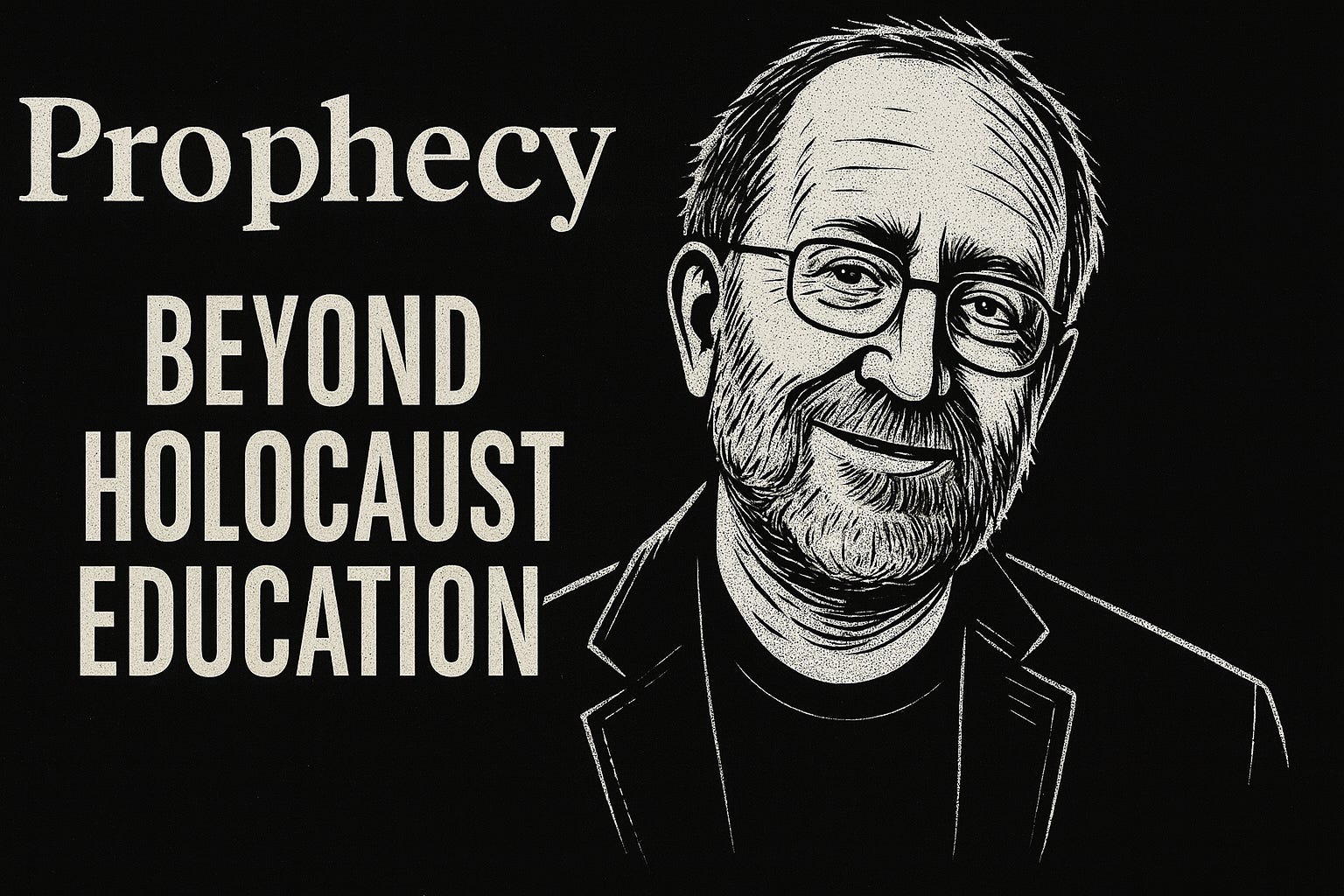
One of the books which impacted us the most was Yossi Klein Halevi’s At the Entrance to the Garden of Eden, a book he published in 2001, which changed our understanding of Judaism and Zionism. It is not an exaggeration to say that Yossi is one of the most important Jewish public intellectuals alive, and one of the wisest people we have had a chance to learn from.
Over the course of the years we’ve followed Yossi, we have heard him speak about how his worldview was largely framed by the experiences of his father, a Holocaust survivor who moved to Brooklyn after the war. We knew that Yossi played a central role in Holocaust education programs over the decades, and therefore were deeply affected when we heard Yossi say that in the wake of October 7 we needed to rethink how we taught about the Holocaust from the ground up. It is our privilege to publish our notes from our conversation with him about how we should be thinking differently about the Holocaust - a subject we know he is working on for a future book.
Beyond Holocaust Education
On Sunday, September 14, 2025, we had the pleasure of speaking with Yossi Klein Halevi about his thoughts on the future of Holocaust education. We’re pleased to share with you our notes from the call.
The purpose of Holocaust education, as it was conceived by the generation of the survivors, by Elie Wiesel and by the people around him including Rabbi Yitz Greenberg – the two of them founded the Washington Museum – was frankly to protect the Jewish People. The approach was different in Israel and in the Diaspora, but it was the same goal.
In Israel, it worked by inspiring high school students through trips to Poland to have greater motivation to serve in the army and volunteer for elite units and be part of the defense of the Jewish People. “We’re going to show you the consequences of Jewish defenselessness, and you are part of a generation that has been blessed with the possibility of taking up arms to defend the Jews.” That was how Holocaust education has played out in Israel to this day.
In the Diaspora, especially in America, it worked in some sense in an opposite way. The rationale for Holocaust education in America was: “We’re going to teach the Gentiles the consequences of antisemitism. We’re going to shock them into facing the results of hatred for the Jewish people. As a result, they’ll be nicer people.”
Since this was America, Jews needed to approach Holocaust education in as broad a way as possible. So yes, we were going to use the Holocaust as the most extreme example of what happens when you hate the other. But in the spirit of America, we were going to expand the parameters of Holocaust education to include other forms of genocide, like the Armenians or Rwandans.
A major purpose of Holocaust education in the Diaspora was to teach young people not to be bystanders. Elie Wiesel promoted this idea relentlessly: “The only thing worse than being a perpetrator is being a bystander.” This was his message, which I personally think is morally untenable. The only thing worse than being a perpetrator is being an even greater perpetrator.
So what happened on October 7th? These two approaches to Holocaust education were each put to the extreme test, in Israel and in the Diaspora.
In Israel, October 7th was the negation of the promise of self-defense. The shame of October 7th (and this is going to be an enduring shock; not even our victories against Hamas and Iran will undo the psychological damage) is now imprinted on our generation. The shock is that we failed. Not only did we leave the border open, but the army effectively disappeared and citizens were forced to fend for themselves.
But we quickly recovered from the temporary lapse into victimhood. If anything, October 7 reminded us of the consequences of powerlessness and has reinforced the Israeli goal of Holocaust education as Jewish self-defense.
The greater challenge to Holocaust education on October 7 happened in the Diaspora. There, not only did the premise fail, but it was turned against itself. The Holocaust became a potent weapon against the Jewish people. And that’s expressed with the accusation of genocide, which began before we even really began retaliating. On October 8th, we were already being accused of genocide.
What young people did on campuses around the West was take all they had learned about the Holocaust and turn it against the Jews. What they did with this constant admonition of “don’t be a bystander” is to conclude that they are forbidden to be silent against Israel.
So the urgent question is: how did it get to this point? How did we allow ourselves to be so vulnerable? How has this tremendous effort to teach the world lessons of the Shoah become a weapon against us? Just when we needed a nuanced understanding of what the Jewish people are up against, we found ourselves in front of a firing squad. And we gave those kids the guns.
The fatal flaw of Holocaust education in the West, especially in America, was to universalize the Holocaust and to subsume it in the generic category of racism. Racism needs to be treated as its own discipline. Racism works differently than antisemitism. Each of course has horrific consequences. But each needs to be understood on its own terms.
The first quality of antisemitism is its obsessiveness. Just before Hitler committed suicide, he wrote a testament to the German people, and concluded, “Above all, fight the Jew.” Above all. His empire is going down, and this is what he’s preoccupied with. The Holocaust was an expression of the all-encompassing obsessiveness of antisemitism.
Second, antisemitism is noted for its adaptability to seemingly any ideology or belief. It’s the process of turning the Jews into a symbol of whatever a given civilization defines are its most loathsome qualities.
Holocaust education needs to switch from the broad category of genocide and hatred of the other to emphasizing the uniqueness of antisemitism and how it works.
The purpose of emphasizing antisemitism is not to make the world feel sorry for the Jews. The goal is to help them understand how this particular pathology works.
Holocaust education also needs to deal with the post-Holocaust era. Obviously, kids need to understand what happened in the Holocaust: the 12-year process that began with otheringand criminalization, escalated with ghettoization, and ended in extermination. We need to teach that progression. But there’s a missing piece in that progression: the end of the story, how we overcame.
The Torah offers us a framework. The biblical narrative tells the story of slavery in Egypt, but that’s not the main focus. The real focus is the Exodus and the 40 years of the desert, and then the entry into the land. In other words, the slavery in Egypt is treated as an indispensable starting point for the story, but it’s a prelude to the main story: how does this nation of slaves deal with freedom?
The Jewish people overcame the Holocaust thanks to Zionism. We did it by actualizing the great dream we carried through the exile – an absurd dream, really, that the most powerless people would figure out how to gather itself from a hundred diasporas, return home and reestablish its sovereignty and power. We overcame the Holocaust by transcending reality – responding to our worst nightmare with our most inconceivable dream.
Practically, the post-Holocaust success story was based on an alliance between Israel and American Jewry, the two great Jewish population centers. Each strengthened the other. What gave Jews stature in the America of the 60s and 70s was not the Holocaust. It was overcoming the Holocaust. It was Israel.
25 years from today, what would I hope a young person who has gone through Holocaust education would understand? Maybe that turning the Jews – or in our case the Jewish state – into the symbol of evil is part of an ancient pattern. And also to understand that the key to human experience is not victimhood but overcoming victimhood. That seems to me an especially important lesson for young progressives.
***
Yossi Klein Halevi is a senior fellow at the Shalom Hartman Institute in Jerusalem. Together with Imam Abdullah Antepli of Duke University, he co-directs the Institute’s Muslim Leadership Initiative (MLI), which teaches emerging young Muslim American leaders about Judaism, Jewish identity and Israel.
Halevi’s 2013 book, Like Dreamers, won the Jewish Book Council’s Everett Book of the Year Award. His latest book, Letters to My Palestinian Neighbor, is a New York Times bestseller. He writes for leading op-ed pages in the US, including the Times and the Wall Street Journal, and is a former contributing editor to the New Republic. His first book, Memoirs of a Jewish Extremist, tells the story of his teenage years as a follower of the militant rightwing rabbi Meir Kahane, and his subsequent disillusionment with Jewish radicalism. The New York Times called it “a book of burning importance.”
In 2013 he was a visiting professor of Israel Studies at the Jewish Theological Seminary, and served as a writer in residence at the University of Illinois. He was a senior fellow at the Shalem Center in Jerusalem from 2004 until 2010. Born in Brooklyn, he moved to Israel in 1982, and lives in Jerusalem with wife, Sarah, who helps run a center for Jewish meditation. They have three children.