

Beyond Judaism
By Hillel Halkin
In which Hillel Halkin meditates on what lies past Judaism as a set of ideas guiding the Jewish People, questioning whether the Jewish spiritual project can—and should—transcend its inherited forms.
But first, let’s get to know the person behind the piece: Hillel Halkin
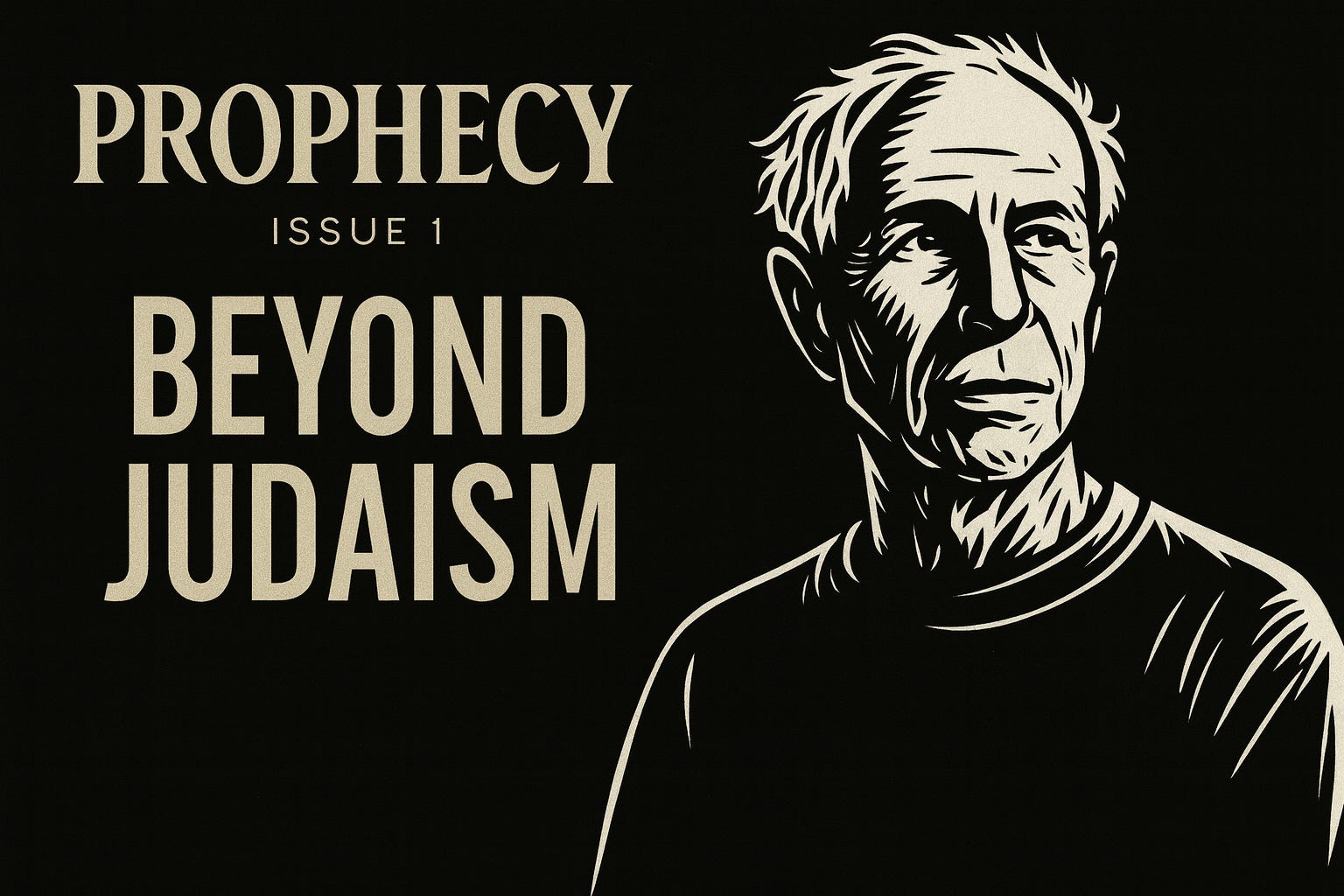
There are few people who have had as deep of an impact on the connection between the Diaspora and Israel as Hillel Halkin. If you read Hebrew literature in English, there is a near certainty that you have read books or poems he has translated, or influenced the translation of, from Hebrew to English. If you have read essays on Zionism and its worldview, you have certainly come across him, learned from him, and been imprinted by his unique perspective.
In a conversation over lunch we asked Hillel what concerned him about our present and our future. We spoke about the trials and tribulation of the current government, the question as to whether Israel could survive as a unified state, and kept coming back to what Hillel felt was the root of our challenge: the very concept of choseness that perhaps gave us the confidence to survive Exile but has kept us isolated and in his opinion hated since. We did not agree, but since neither Hillel nor we are willing to shy away from controversy when it comes to the core questions affecting the future of the Jewish People and the State of Israel, we are proud to share his thoughts with you in our pages.
Beyond Judaism
By Hillel Halkin
In the Friday night Kiddush, the blessing over the Sabbath wine, there occurs the phrase, regularly recited or sung by millions of Jews every week, Ki vanu vaḥarta v’otanu kidashta mikol ha-amim, “For us You have chosen and by You are we hallowed from all the nations.” Although my wife and I don’t say Kiddush regularly, we do it when our Friday night dinners are held with the family of our oldest daughter, who is religiously semi-observant; and yet in the last several years, I have found myself almost physically unable to utter this phrase. Not that the idea of Jewish chosenness appealed to me before that. But I wasn’t a believer in other precepts of Judaism, either, and I was willing to relate to ki vanu vaḥarta as one relates to a poetic trope, part of a tradition that was mine even if I wasn’t bound by it.
Not any longer. The growing power of the religious nationalism that will, if unchecked, spell Israel’s doom as a Jewish state is no longer simply poetic trope. It is a frightening reality, one based on the belief that we Jews have been singled out for a special destiny that permits us – indeed, commands us – to flout, for the sake of its fulfillment, universally accepted rules of human behavior. Such a belief, and the actions it is used to justify, are not only morally repugnant. They are highly dangerous. Since October 7, they have helped to turn Israel into a pariah state and fuel a mass outbreak of anti-Semitism in much of the world.
But let’s face it: anti-Semitism has always been, in large measure, a reaction to the idea of Jewish specialness. Jews can present this idea as they wish. They can argue that being chosen to be God’s special agent in this world is not a boon but a burden; that it confers more obligations than benefits; that it is about an assigned mission, not an inborn superiority. This may sound reasonable to Jewish ears, but it has never impressed the world. The world, or at least much of it, has quite sensibly replied: “We do not care why you think you are essentially different from the rest of us, we only know that you think it. And if you think you are, we will treat you as though you are. If you want to thank God in your daily prayers, as you do, for not placing you ‘among the families of the earth,’ why should we place you among them? Why admit you to a human brotherhood that you give thanks for not belonging to?”
When secular Zionism was born in the late nineteenth century, one of its main if not clearly formulated goals was to restore the Jewish people to the family of man by reconceptualizing Jewish identity. Instead of being a people scattered all over the earth and held together by a unique sense of religious destiny, the Jews would become a people like any other, defined by territory and language – that is, by Hebrew and the Land of Israel. Whoever lived in this land and spoke Hebrew as a native language would belong to the Jewish people, just as whoever lived in France and natively spoke French belonged to the French people.
Such a Jew might practice or engage with Judaism just as a Frenchman might do with Catholicism, but he would be no less Jewish if he didn’t. He would be Jewish in the way that people everywhere partake in a national identity, and there would no longer be a difference in this respect between him and them.
In a word, Jewishness, not Judaism. For a long time, in the years before and after Israel’s creation as a Jewish state, secular Zionism seemed to have attained this goal. And yet because, apart from its more radical wing, it was never able or willing to articulate the goal clearly, in part because it wished to avoid offending religious Jews and in part because it feared the goal’s implications, it backslid practically from the start.
Even an avowedly secular Israeli leader like David Ben-Gurion, who practiced no aspect of Judaism, clung to the idea of Jewish specialness when repeatedly speaking of Israel’s becoming “a light unto the nations” -- an absurd ambition on the face of it for a nation that has proven less and less capable of being a light even unto itself.
Little by little, secular Israel has retreated from the goal of a Jewish state committed to Jewishness rather than Judaism. One sees this everywhere, in big things as in small, from the refusal to contemplate granting non-Jewish immigrants to Israel and their children entrance to the Jewish people without a religious conversion to the pathetic custom of secular politicians wearing kippot at memorial gatherings for fallen soldiers or victims of the Holocaust.
And one sees it of course in the biggest things of all: in secular Israel’s endorsement of a policy of denying Israeli Arabs full equality because Jews are more equal than others; in ruling out the establishment of a Palestinian state because all of the Land of Israel is Jewish by divine right; in the reckless readiness to fight a war in Gaza that has turned the world against us because the world is against the Jews anyway and we will always be, as the Bible says of us, “a people that dwelleth apart.”
A chosen people is a people that necessarily dwells apart. Can one conceive of an authentic Judaism that surrenders this concept – that changes mikol ha-amim to im kol ha-amim, “From all the nations” to “With all the nations”? Although attempts have been made to do this, I honestly don’t see how it is possible:
Judaism, with all that is good and bad about it, loses all meaning and integrity when deprived of the belief that the Jews are God’s people as no other people is. One can’t get around this. One can only go beyond it.
***
Hillel Halkin was born in New York City in 1939. In 1970 he and his wife made aliya to Israel, settling in Zichron Yaakov. He has translated some seventy works of modern Hebrew fiction into English, among them classics by such authors as Agnon, Brenner, and Amos Oz. Halkin has also written weekly columns for the Forward, the Jerusalem Post, the New York Sun, and the Jerusalem Review. Hailed by many as one of our greatest contemporary Zionist thinkers, Halkin has authored more than half a dozen books, including: Letters To An American Jewish Friend (1977): Across The Sabbath River (Houghton-Mifflin, 2002); A Strange Death (Public Affairs, 2005); Yehuda Halevi (Schocken Jewish Encounter Series, 2010); Melisande! What Are Dreams? (Granta, 2013); a biography of Vladimir Jabotinsky (Yale University Press, 2014); Lives of the Children of Manasia (Gefen, 2022); and The Lady of Hebrew and Her Lovers of Zion (Toby, 2020).
Halkin fires his barbs at chosenness while studiously ignoring its only real foundation: prophecy. The only issues worth exploring are the two that underpin Jewish chosenness – the value of prophecy and the possibility for Israel to attain it again.
The modern ear winces at “For us You have chosen” in the kiddush, yet no one objects to the haftarah blessing: “Who has chosen good prophets and took pleasure in their words spoken in truth.” If the prophets uniquely spoke for God, then – by definition – they were chosen by Him. The only question worth asking is whether that claim is true and whether Israel can reclaim that role.
It is that claim alone that is worth analyzing: Do the prophets teach something sublime, divine? And, is it true, as they claim, that the Jewish people uniquely will one day reclaim the same ability?
Far from being a function of the exile, the notion of chosenness has always been about the future, about the possibility to reclaim the role of speaking for God. Chosenness is much bolder than the facile apologies of it being a burden, that it confers obligations, that it is about a mission and not an inborn superiority. Rather, it claims that historical contingencies have made this people uniquely capable of speaking God’s word, both in their glorious past – when an Isaiah, an Amos, a Malachi walked in their midst – and in their hoped-for glorious future, in which their “sons and daughters shall prophecy” (Joel 3:1).
Halkin is right that mealy-mouthed apologies for chosenness (“it’s really a burden!”) never convinced anyone. Actual prophecy, however, has always commanded attention. But Halkin refuses to state the only possible argument: either that the prophetic way should not impress anyone, or that it no longer is associated with a specific nation. By failing to make that his argument, he is guilty of the very sin of which he accuses others – making chosenness something independent of an underlying, verifiable reality.
The teachings of the Torah and the prophets are, in my opinion, utterly sublime and otherworldly, and we have only begun to plumb their depths (Interested readers: my Substack and archive here: https://shnayor.substack.com and here: https://linktr.ee/rabbishnayorburton). Prophecy lies behind us and before us too. And chosenness follows from that idea. For no sublime idea can float unembodied; it requires a concrete place, time, and persons to bear it in its fullest expression. Even if prophecy is theoretically universal – and I believe it is – in order for it to be meaningful, it must be concentrated in a particular people, land, and language, or it evaporates into sentiment.
Perhaps one should attempt to become a prophet and then reevaluate the notion of chosenness. I venture to say that it would be a manifestly obvious and necessary doctrine.
Halkin all but admits that his argument is not against Jewish chosenness as such but against Judaism itself; it would have been more honest and more edifying to say so outright.
Oh, and about David Ben Gurion – he was far from someone “who practiced no aspect of Judaism.” He studied Torah and developed the Land of Israel, arguably the two most central commandments of the whole Torah.
Interesting take by, at least for an English reader, the best person to make it. Thank you Ariel for publishing it.
Hillel's failure to articulate any idea of what getting beyond Judaism would actually entail should however be read as the final nail in the coffin in the idea that such an outcome is possible.
Hillel alludes to but doesn't endorse the anti-Judaism strain of secular Zionism, embodied in the old Canaanist movement that I'm sure he knows better than I do. This is a tell.
The problem with that perspective was how close it hewed to Jew-hatred and the incoherence of a state whose deepest lived value is to be a refuge for Jews. What to do with all those refugee Jews who stubbornly cling to traditional Judaism? I'm confident Hillel does not need to be reminded of the evils of the experience of the children of Mizrachi refugees placed in anti-religious Stalinist kibbutzim.
Not that things have gone any better in the diaspora, where versions of Jewishness divorced from Judaism hold, as they do in Israel, to the last remnants of anti-democratic communal power they assumed in the mid-20th century while those Jews who care most about being Jewish become ever more focused on the longest-lived aspects of Jewish tradition.
The answer is not getting beyond Judaism. It is articulating and making real a new Judaism that engages seriously with the dramatic upheaval of the reestablishment of Jewish sovereignty in the Land of Israel.