

Beyond Orthodoxy
By Zev Farber
In which Rabbi Dr. Zev Farber challenges Orthodoxy’s structure of control and calls for a reimagined, pluralistic approach to halakha and religious community.
But first, let’s get to know the person behind the piece:
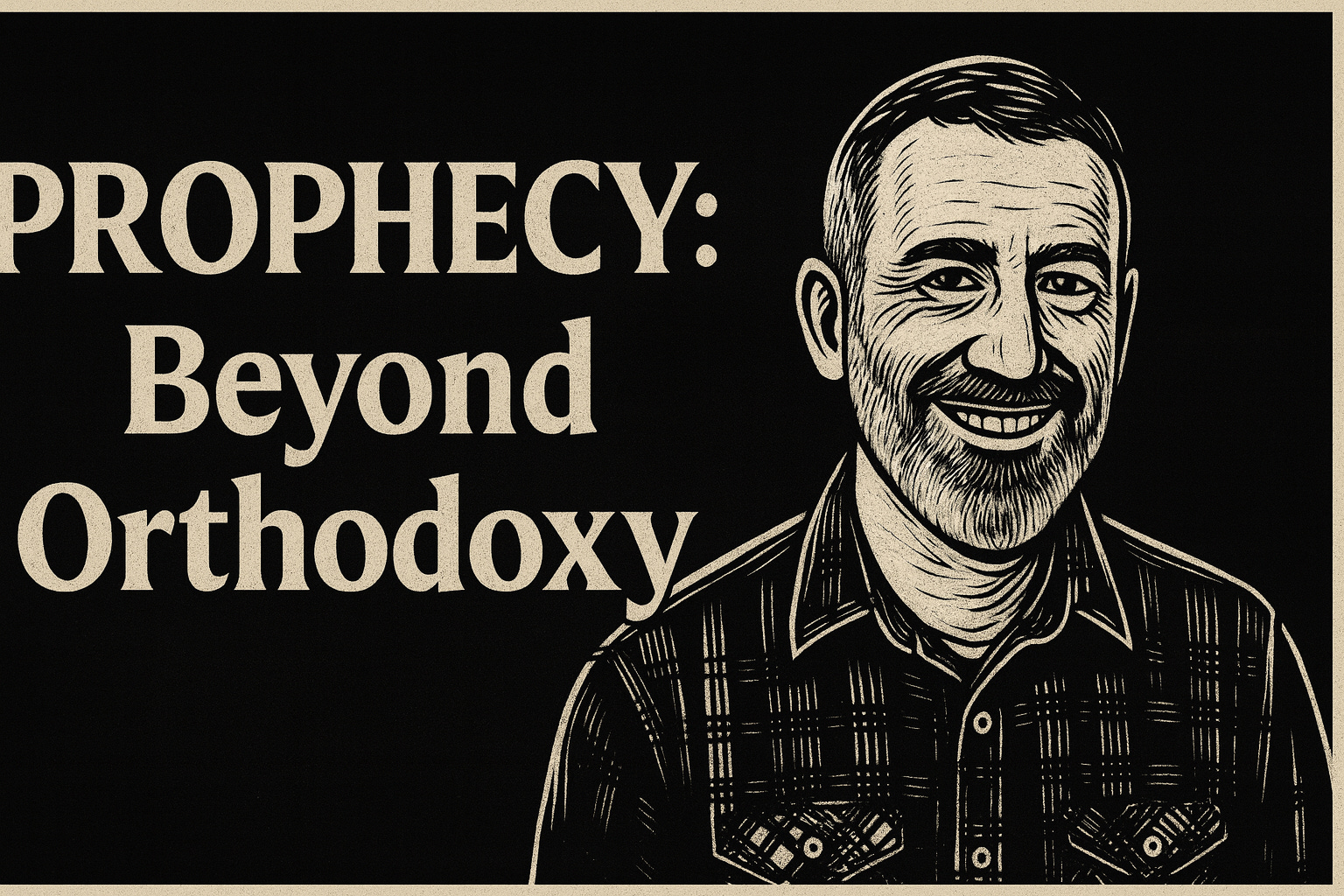
We met Zev over a shabbat in Zichron Yaakov, Israel, and were immediately struck by his approach to Judaism and the world.
Zev, who earned his smicha (ordination) as an Orthodox rabbi and received the degree that qualifies him to be appointed as a dayan or judge in a Jewish halakhic court, has not shied away from taking on difficult topics such as Judaism’s approach to homosexuality, transsexuality, and the ancestral memory of our people, always finding a personal, sensitive, human way to work through topics that others may address clinically or categorically. As we spoke with him about our mission at Prophecy we realized he would be the best person to address a topic that we’ve been wrestling with for a while: Orthodoxy and how it is lived, especially in Israel, where it has become synonymous with Judaism.
Beyond Orthodoxy
By Rabbi Dr. Zev Farber
The Israeli dating app called Dateland (Israeli culture has never excelled at subtlety) includes questions about religion, some of which I had difficulty answering when I signed up.
“Do you keep Shabbat?” That’s an easy question; I went for yes. “What is your connection to Judaism?” That’s a little harder. On one hand I received smicha (or certification) as an Orthodox Rabbi and even advanced smicha as a dayan, i.e., someone qualified to be a judge in religious courts. On the other hand, I’m an outlier in the Orthodox world and don’t share most Orthodox people’s ideology, so I put “I keep the traditions.”
“Do you keep kosher?” This was tricky. I’ve always kept kosher, but I do eat dairy or vegetarian out, especially in Israel. While I can defend this halakhically (within the framework of Jewish Law), it isn’t what most people perceive as keeping kosher, which is only eating in restaurants with hashgacha (rabbinic supervision), a principle I object to for several reasons. At the same time, it isn’t “let’s get cheeseburgers” either. I skipped the question, but it doesn’t end there.
Conversations with native Israeli (as opposed to an Anglo) chiloniyot (secular women) my age inevitably go like this: “Wait, are you dati (religious)?” “Sort of, I’m traditional.” “Do you keep Shabbat?” “Yes.” “But I like to go out Friday nights?” “I hear that, do you go out any other nights?” “Yes, but I don’t want to keep Shabbat?” “I understand. We haven’t even met for coffee yet. If we fall in love and come to life partnership, we could probably work something out.” “But is it worth trying?” At this point, when it begins to feel like West Side Story for middle-aged divorcees, the matter is generally dropped and on to the next interrogation.
With datiyot (religious women), it goes a little differently: “Oh, you live in Zichron? What shul do you go to?“ “I go to a partnership minyan where women also lead part of the services.” “So you’re Reformi?” (This term is the Hebrew catch-all for someone who does Jewish stuff but not in the way you’re used to) “No, people in the Reform movement generally aren’t observant.” “But this feminist stuff…” “Yes, it’s a value to me.” “What other stuff don’t you do normal? Do you believe in Torah and God?” “Well, I’m a fan of both, but my belief is complex.” At this point, we fall into a discussion of faith and values, with every possibility of a light-hearted get-to-know-you-over-a-beer disappearing into the ether.
Why does this happen? I believe the sharp break between Orthodox and non-Orthodox has created a rigid identity structure that is hard to navigate, and the natural impulse is for each group to retreat into its own subjective normalcy. Control over this process is left to the community’s leadership, who function as gatekeepers, with the ability to reward and punish, socially speaking.
The ossification of serious religious commitment makes it impossible for people to live in the much healthier interstitial spaces between fundamentalist adherence and scornful apathy. The lack of room for individuality is especially problematic when it comes to values.
Another example: A few years ago, I took some visiting family members for a tasting at a boutique winery near my home, run by the parents of one of my daughter’s friends. When the vintner saw my kippah, he said, “you know my wine isn’t kosher, right?” I asked humorously if he puts lard on the corks. “Of course not,” he laughed “it’s just that I’m not religious, so I was told my touching the wine makes it unkosher.” I was, of course, aware of how the Orthodox kashrut establishment treats non-observant Jews as if they were gentiles, but I explained that I don’t accept that halakhic stance as it offends my sensibilities.
Even the overarching principle – not to drink wine made by a gentile or to eat food cooked by one – is offensive to me. I was once returning from a shiva call and stopped at a small kosher-burger stand. The man behind the grill was an Arab, and when I ordered the burger, out came the Jewish manager, who put the burger on the grill and went back inside. The point of this act was so that the non-Jew would not technically be the only cook. I remember feeling mortified and telling myself that I simply have to discount this law.
So I eat dairy or vegetarian at not hechshered restaurants and ignore the rules about gentile cooking and wine – does this mean I don’t keep kosher? One could make that argument, but then what does it mean that I eat only shechted (ritually slaughtered) meat and don’t mix meat and dairy? Doesn’t that mean I do keep kosher? Or does it just mean that I do not submit to the control of a certifying authority over which I have no control and with which I cannot disagree? Our categories are not robust enough to describe this liminal path, religious commitment beyond Orthodoxy. There needs to be room for such objections within the Orthodox community’s identity structure.
When it comes to the treatment of women, the matter is even more urgent. Take marriage laws. In the traditional Jewish marriage written into the law in the modern State of Israel (kiddushin), a man acquires sexual rights to the woman when she accepts the ring under the chuppah, and he continues to hold such exclusive rights until such time as he gives her a gett (a bill of divorce). She may refuse to sleep with him or even live with him, but if he refuses to participate in the gett ceremony, she is an agunah, prohibited from intimacy with another man.
When a woman says to me, “I will not marry in a religious ceremony since I don’t want to be stuck,” I totally understand the sentiment. Indeed, I would feel the same if an agunah would say to me, “Religion is a nice thing, but I’m not going to give up having a relationship just because, in some abstract sense, my ex-husband is keeping us Jewishly married.”
Admittedly, such a woman would not be following Orthodox norms, but does this mean she is not religious? On the contrary, I believe there is much to commend a person who will not participate in the degradation of God and Torah that the Orthodox community does by kowtowing to this tradition.
Or take the community’s approach to sexuality, a parade example of a conservative desire to control people’s sexual impulses by limiting all such expression to the confines of marriage. (I am speaking, of course, only of heterosexual impulses; homosexuality is dismissed in the best of cases and persecuted in the worst.) And even in marriage, the couple is supervised.
For example, the laws of niddah prohibit a couple from engaging in physical intimacy during menstruation. This relatively simple law is made complex by a series of required “checks” at the end of her cycle, and when matters are unclear, couples are told to take the question to a rabbi, who will inform them when they can have sex again.
Control is also maintained through the use of mikvah, where mikvah ladies, under the authority of rabbis, determine whether the woman has prepared properly, dipped properly, and may even bar her from using the facilities if the couple isn’t married or if she refuses to follow ritual guidelines.
Control is similarly asserted in the ostensible requirement for unmarried people to be shomer negiah, i.e., not to touch at all, and the concomitant practice of separating the sexes at a young age to “ensure” compliance. This unhealthy preoccupation with controlling sexuality creates real difficulties for young people exploring their sexuality and deciding on whom and when to marry.
The need to control sexuality also lies behind the rules of tzniut “modesty,” a misnomer if ever there was one. Girls are told that they must cover their knees and elbows, even though these are not considered sexy in our culture, also that they cannot wear bathing suits at the beach or pools, even though this is standard dress in such situations. Girls must always wear skirts or dresses, never pants, may not sing in public, and must cover their hair when they are married.
This oppressive list of requirements oversexualizes girls/women, making them fear their own bodies and see men as out-of-control desire machines, who cannot be in the presence of casually dressed women.
Many religious people ignore these rules, but if one declares their principled rejection of them as socially backward or unethical, one is considered un-Orthodox, even when the objection comes from people who dress conservatively, are not promiscuous, keep Shabbat and kashrut, learn Torah, go to shul, etc. In other words, from people whose lifestyle is not secular at all.
The current rigid constellation gives off a feeling that Orthodoxy has become inextricably linked to control as opposed to religious observance. If we want to allow for a fuller expression of values in the context of religiosity, spirituality, and a life of godliness, members of good conscience must go beyond Orthodoxy and redefine what it means to be in a community of observant, dedicated Jews, in which individual members have power, with room for difference and exploration.
Part of creating an identity beyond Orthodoxy is internal work, being more understanding of each other’s values and life-needs. Less judgmental. We do not need to treat the Torah like a fragile piece of glasswork. It is a robust, millennia-old tradition that has always adjusted over time and place. We do not need to have institutions control what is permitted or denied and in doing so deny our ability to make choices based on our own values and understanding of tradition.
The other part of this work connects to how our community relates to others. Let’s look at one further challenge to illustrate this, the ethnocentrism which has crept into religious Zionism.
My children go to a democratic pluralistic school, but years ago, my younger son attended first grade at a religious Zionist school. It was our first year living in Israel and the rabbi of the school quoted the Talmudic saying, “the world exists because of the breath of school children,” a beautiful metaphor about the power of education to affect children. Then he said, “People think that world leaders, scientists, and scholars are driving the world, but really, what they (= gentiles) are doing is nothing and has no value.” I said (loud enough for the people next to me to hear) that I was glad my son didn’t know Hebrew yet, since I would hate to have to explain this offensive piece of silliness.
Is there some reason we cannot be proud of our children and heritage without being scornful of other cultures and their accomplishments? Does it really serve our kids to tell them when they memorize a verse from the Torah they are contributing more to the world than a scientist curing cancer? What kind of artificial ego are we trying to give them? Don’t we want them to be ambitious and accomplish great things in their own lives? Whose mediocrity is such an attitude designed to protect?
I think that one reason such attitudes have become grist for the mill in our society is the need to use our religious-Jewish identity as a bulwark against the chaos that many feel is plaguing modern society, and to reward those who choose to live within the Orthodox community for giving up their individual judgment in return. But the solution is not to sacrifice our values and selves for the sake of membership in a club whose rules we cannot control. We can adopt Torah traditions while adapting them to our contemporary values, as have countless generations before us.
The path towards a rich religious life lived according to halakha that does not justify the continued control nor its supposed reward begins with dissolving our practice of community insularity and forming real friendships and partnerships with those who are not like us, whether it be secular Jews or non-Jews. This requires mixed institutions, cultural fluency, and, in the case of Jews and Arabs, linguistic facility.
All humans are created in the image of God and beloved by their creator. Internalizing this principle may be the key to establishing new community networks and religious commitments that are deeply held, yet fluid, personal, open to adjustment from within and without. The religious Jewish world should participate in this trend as equals, who have much to learn and much to offer.
It would mean crafting a religious community which allows for variation in practice and thinking when it comes to halakha, without a central authority rigidly deciding. Rather, authorities would act as facilitators for people’s ritual or educational needs, trusting the strength of Torah and the Jewish People’s affinity to our millennia-old tradition. This is what it would mean to go beyond Orthodoxy.
Rabbi Dr. Zev Farber is Senior Editor of TheTorah.com for the Academic Torah Institute and Founder of Prisma, which aims to "tap the wisdom of world religions, skip the dogma." He is co-author of The Bible's First Kings (Cambridge University Press) and editor of the two-volume set Halakhic Realities on brain death and organ donation. He has written tens of articles on biblical criticism, theology, and halakha aimed at general audiences, as well as op-eds on Jewish topics including Israel, ethics, and LGBTQI+. Links to his articles and books, including his fiction works, can be found on his website zfarber.com.
I'm finding it confusing how you decide which laws to keep. Only the ones that make sense to you? If you believe Torah min shmayim then it would be trite to expect the divine law to exactly match whatever you could have come up with yourself, and if you don't then there are probably much bigger beliefs shifts called for and your references to authority from eg rishonim are spurious
I feel the need to make a division here.
1- Internal (Continuity/Authenticity)
This kind of criticism claims that some part of a religion is not a real representation of it. For example, a claim that Orthodoxy distorts the ordinary proportions of Judaism as it was decades and centuries earlier.
2- External
Evaluating a given sect or group on the basis of some external ethic or rival moral vantage point. A deontologist for example can point out that Judaism lacks the absolute moral clarity provided by Kant, and a consequentialist can say that too much legalism can prevent a good result.
Regarding 1, this is a difficult path. “Authentic” Judaism may not be any one thing, certainly not historically as you well know. Which developments are seen as a natural continuation or offshoot tend to be very silly.
Regarding 2,
Judaism, if good for anything, must to a large extent reject presentist ethics. Evaluation from an external moral vantage point is subject to questions regarding the validity of that standpoint, and the standpoint of that question in infinite regress https://philarchive.org/archive/GOMIMM
A good example you mentioned to illustrate this is women wearing bikinis on the beach. This being the practice of contemporary culture, and eschewing it being sexual repression, begs the arguement of what degree of exposure is a good idea in general, and what degree is best in a society that may have gone a bit far with it.