

Beyond Zionism
By Ariel Beery
In which Ariel Beery argues that Zionism’s success calls us to integrate it into the rhythms and rituals that evolved over the history of the Jewish People, and that by doing so we will emerge into a new phase of our lives as a People.
But first, let’s get to know the person behind the piece: Ariel Beery
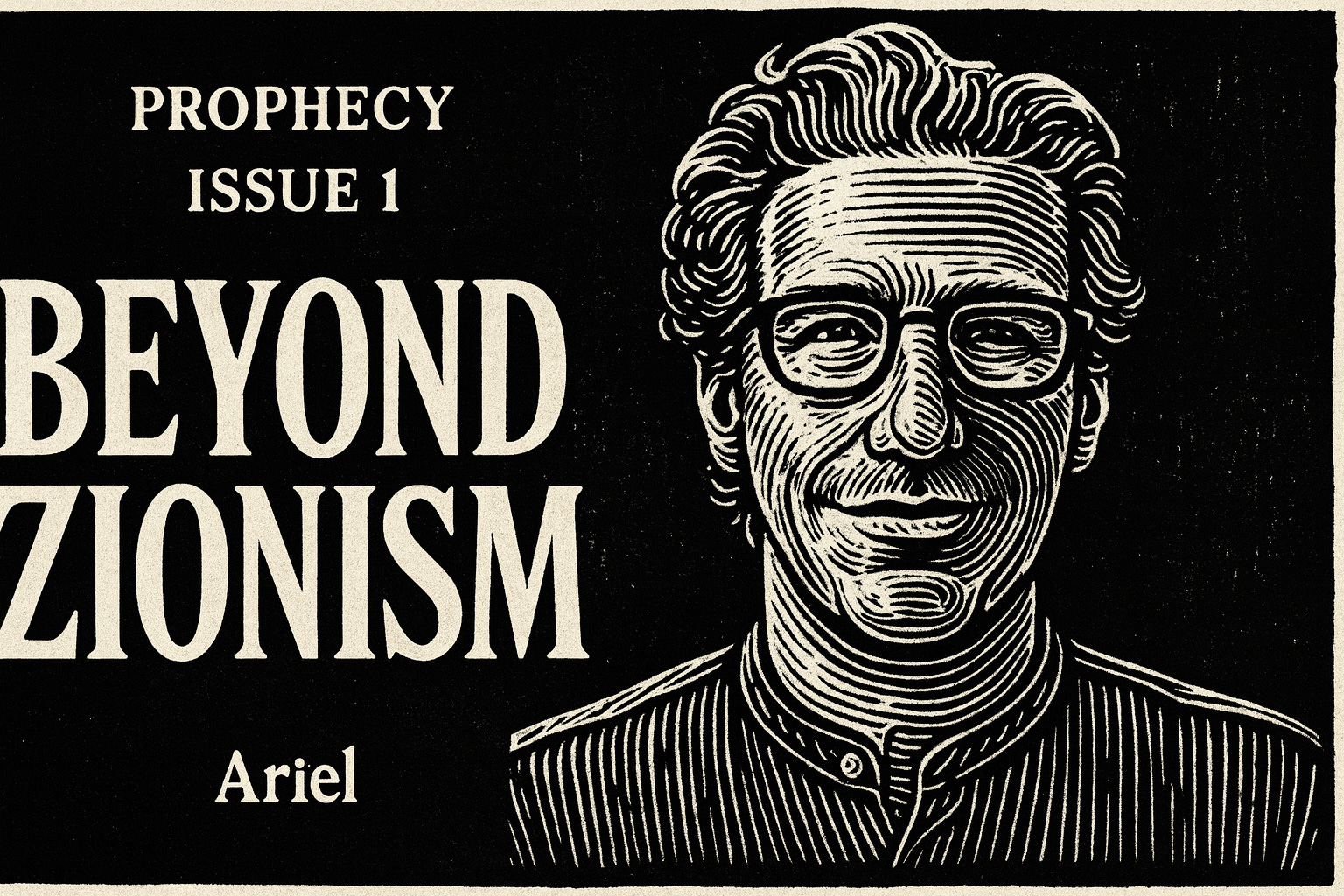
Ariel is the founder, editor and publisher of Prophecy - a project he started in the hope of catalyzing a new type of conversation among Am Israel, one focused on the future we can live together as informed by our values and traditions. There is irony in this, since 20 years ago in 2005 he founded PresenTense with the intention to bring light to the incredible amount of social innovation in Israel and across the Jewish Diaspora at present. At the time, he responded to the feeling that the Jewish People should celebrate the creativity of the here and now; with Prophecy, he is responding to the observation that the Jews have been so distracted by the pains of the present and the troubles of the past that they – that we – lack the political imagination to build a shared future.
Ariel has written quite a bit about Judaism and Zionism on his substack, A Lighthouse, and over the past year has kept coming back to the same question: why is it that we seem to separate the two ideas and their implications when so many of us, not to mention the world, clearly see them as one and the same? And what would happen if we were to recognize that Zionism is, in fact, an evolution of Judaism, and its success requires a redefinition of the ideas that keep us in covenant?
Beyond Zionism
By Ariel Beery
Judaism is the word we use to describe the beliefs guiding the life choices of the Jewish People. One can both believe that Moses received the Torah on Mount Sinai and passed it on to Joshua, and from him to the Elders, and from the Elders to the Prophets, as the Mishna’s Pirkei Avot tells us, while also recognizing that Judaism has, over time, evolved and integrated practices and tenants of faith to help our People live as a covenantal community (a community voluntarily created and maintained) in a changing and challenging world.
The Jewish People and Judaism have been evolving for as long as we have existed. In ancient times when animal sacrifice was the norm, Judaism described the ways and means of sacrificing to find favor in the eyes of the Eternal through representatives that just so happened to be a landless tribe that lived among us. These Levites served to build commonality and maintain identity through guiding the sacrificial offering and divining right action. In later years, when kingdoms arose in our region and we sought to be like other nations, Judaism evolved to center the role of the king and the kingdom, gathering these same Levites near his palace in Jerusalem into a single Temple. In response to this centralization of power, Prophets arose to preach morality and represent the interests of the powerless within our community, adding a layer to Judaism defining how we think today about our covenant and its daily implications.
Following the destruction of that Kingdom and its Temple, Judaism became portable so that it could maintain the connection between our people in exile. At the heart of the exilic version was the story first spoken and then read to the community on days dedicated for communal gathering. As that community grew, and a new kingdom was formed around a new Temple built, Judaism evolved further; Sages replaced prophets and commentary replaced prophecy as a means of guiding the behavior of the far-flung people and identifying the guardrails which marked the Jewish way.
It was after the second destruction of the second kingdom and Temple that Judaism disconnected from the sacrificial practices of its youth and matured into a fully portable, fully distributed system of ideas for how to live the good life. Unlike the practice of philosophy of the Greeks, which sought to describe universal truths, Judaism was based on one fundamental assumption: our people have a unique relationship with each other that enables us to maintain a covenant with the Creator. We left divining universal truths to others; our concern was how to live the good life, together.
Despite the pain and suffering, despite being disappointed in how that covenant was upheld by our Eternal partner or by our leaders or by ourselves, we remained loyal to that relationship by redefining it again and again to adapt to changing times: in the age of empires we maintained tight communities who traded amongst themselves, in the age of religions we added explanations not existing in our initial stories such as what happens after we die. Under the guise of the inquisition we found means to hide and adapt and escape and be reborn through the ideas of luminaries such as the Rambam. In the shadow of the enlightenment we redefined how one could be a Jew in the home and a man in the street, giving birth to the three denominations that most Jews today claim to adhere to: Orthodoxy, Conservatism, and Reform. For every age, an intellectual season. Factions championing certain ideas arose and others fell. Judaism evolved to become what we know it as today and remains a means to describe the different beliefs the Jewish People use to guide their everyday lives.
Zionism is no different. The Zionist idea was born in the throes of Empire, as nation-states declared their independence and defined their social and geographical boundaries. Zionism may have started as a small sect within the Jewish People – much like the Pharisees had before – but it grew. Now, more than half of the Jewish People live in the State the Zionists built, and the Judaism of the Jews living outside that State has been irrevocably changed. Belief or disbelief in that State affects their life choices, their very identity. As a result, Jewish life and belief is fundamentally different today than it was prior to 1948. Zionism, in other words, has (once again) redefined Judaism.
Recognizing that the grand majority of the Jews have moved beyond Zionism as a separate set of beliefs and integrated it into the very core of their beliefs – that is, into Judaism – explains why anti-Zionism is seen by so many as antisemitism. Why so many Jews reject the world telling us, once again, what we should believe and how we should act. Why the Boycott, Divestment, and Sanctions (BDS) movement in academia and cultural circles feels less like a protest and more like the Inquisition. Why it is so easy for anti-Zionists to defend attacks on Jews, and why Jews are unwilling to give up their Zionism despite the rising threat against them.
It is time for us to move beyond describing Zionism as a separate and distinct belief from Judaism, and towards an understanding of the practices and beliefs of Zionist Judaism. Recognizing that we have moved beyond Zionism as a separate idea and integrated it into the covenantal manifest of contemporary Judaism will allow us to properly place it into the practices we’ve developed to maintain and nourish our community.
Just as Temple Judaism gave us a set of holy days and festivals, Pharisaic Judaism brought with it a set of practices and rituals to define Shabbat and Kashrut. Just as Maccabean Judaism brought with it Hannukah and symbols of power and rebirth, Rabbinic Judaism wrapped them all together into the Jewish calendar that sets the pace for Jewish lives everywhere. So too Zionist Judaism – that is, Judaism, post-Zionism – has introduced new dimensions to our beliefs, practices, and priorities. If the past 77 years have enabled us to experiment with the implications of Israel’s rebirth in our daily practice, a post-October 7 world, a world where the impact of Israel on every Jew is undeniable, invites us to learn from those experiments and refine our rhythms and rituals to best reflect the relationship we are hoping to achieve between the Jews and our State.
Imagine a future in which there is no separation between Jewish education and Zionist education, between Jewish holidays and Zionist holidays. When the Zionist thinkers and their Biblical and religious commentary is read alongside Rashi, studied alongside our greatest Sages. When celebrating Yom Hazikaron (memorial day) and Yom Haatzmaut (independence day) is just as natural in Cleveland or Santiago as celebrating Passover or Purim. When education in Israel fills in the gap between the Tanakh and the Palmach with stories of our diversity and celebrations of our global communities. When we have revived pilgrimage holidays convening Jews from across the world in Israel to celebrate together (much like the Islamic Hajj, developed on the template of our Hag: the three holidays in which our people would gather and circle and rejoice).
If we were to build such an integrated future, every Bar or Bat Mitzvah would gain both the ability to read our story to the community and understand that story as part of the continuity of our collective consciousness. Becoming an adult member of the covenant would include the opportunity and even obligation to join our common festivals in our ancient revitalized land, and an invitation to take a part in the actions that define our people. Such an integrated future would unlock a new stage of evolution for Judaism both inside and outside the land. New sages, prophets, teachers, or priests would arise to define the guardrails of our people, strengthen our roots in the soil, and cultivate branches reaching to the ends of the earth. An Israeli Judaism that unifies Sephardic and Ashenazi traditions and infuses a new paradigm with the cultures and practices maintained by the diverse diaspora from Hodu (India) all the way to Kush (Ethiopia).
Moving beyond Zionism also means placing Jewish anti-Zionism in its proper place: as an outlier, a historic anomaly, a minority position that will over time either splinter off or wither away. Just as the Saducees are no more, the Essenes are forgotten, the Karaites are increasingly integrating, and the Neturei Karta have become our adversaries, anti-Zionist Jews who join the global intifada await the same fate. The Jewish State will not go away no matter how hard they cry, and the Jewish People have already decided en masse to integrate Zionism into the set of beliefs that defines their life and times. These anti-Zionist Jews may decide to go one of three ways, as have others when our people made a choice: they may join the inquisition as did Torquemada, they may hide their relationship to family members living in Israel as did the conversos, or they may decide to rejoin our People and accept Judaism as it evolves.
The movement beyond Zionism and into a newly evolved Judaism has already begun, but it is not too late to influence it. Just as Rabbinic Judaism did not steer clear from the hard questions, so too we should ensure Zionist Judaism does not avoid addressing the birthpangs and tragedies and catastrophes caused when we fought to return to our land. Just as the Sages did not shy away from arguing with the Holy One so too Zionist Judaism should accept and even encourage argument with the State and its policies. Just as we are able to recite yearly the Lamentations of powerlessness, we need to learn to grapple with the regrets that emerge from attaining power. Just as the great Jewish generals and sages Isaac Abravanel and Shmuel Hanagid infused Judaism with political philosophy, so too should we devote study to the affairs of state and the morals that should guide us. New prayers will need to be written, old rituals adapted, common festivals reborn.
The institution of prophecy was born with Samuel, who went on to crown the first King of Israel. It co-evolved with the kingdom as a check on growing political and coercive power, reminding the temporal powers of the time that our covenant is not based on sacrifices and worship of the divine, but on proper action towards one another: care for the widow, the orphan, the stranger who lives among us. Prophet after prophet reminded us that the Eternal does not need our praise or support or care. That our fellow human does.
The Zionist visionaries who laid the intellectual and spiritual foundations for the State felt the same way. For them, the State was never an end in-and-of itself. Zionism was always a tool to free Jews to more fully participate in our covenant and live our lives according to the unique set of values and practices that maintained our people over millenia. Instead of defending Zionism, it is time for us to move beyond it. We have a State. Its existence is not debatable. It is central to all of our lives, whether we want it to be or not. However long it lasts (and I pray it lasts longer than our previous attempts at freedom), its very existence will forever imprint how we think about our covenant and our people. We now need to evolve our Judaism once again, to integrate that State into the rhythms and rituals we use to maintain our way of life so that all of us, wherever we may live, may participate in the covenant and find blessing in it.
***
Ariel Beery is a strategist and institution builder dedicated to building a better future for Israel, the Jewish People, and humanity. Ariel has founded and served as the CEO of three ventures: the PresenTense Group (a global accelerator network aiding over 1000 social entrepreneurs to launch ventures since 2005), MobileODT (a healthtech company saving women’s lives in more than 45 countries - acquired), and CoVelocity (a strategic services firm serving governments, foundations, and industrial actors seeking to build innovative solutions to their challenges).
Ariel has worked behind the scenes across a number of efforts in Israel and across the world to strengthen liberalism, safeguard economic competition, and ensure the survival of democracy. He is the proud father of three kids, and devoted to ensuring their world will remain safe, prosperous, and resilient to the changes to come.
I agree with so much of this, and admit that the conduct of successive Israeli governments, and many of its supporters, has tempted me to call myself a Non Zionist, or Diaspora Jew, but what restraining principle is there to prevent Jewish survival from overwhelming the requirement to seek peace?