

Being in which Zev Farber and Ariel Beery call Israel and its neighbors to take action to prevent the coming destruction by the rising seas. They present a grand vision for how the peoples of the Eastern Mediterranean may divert the waters in order to prepare their cities and infrastructure before adaptation becomes impossible.
But first, let’s get to know the people behind the piece: Zev Farber and Ariel Beery
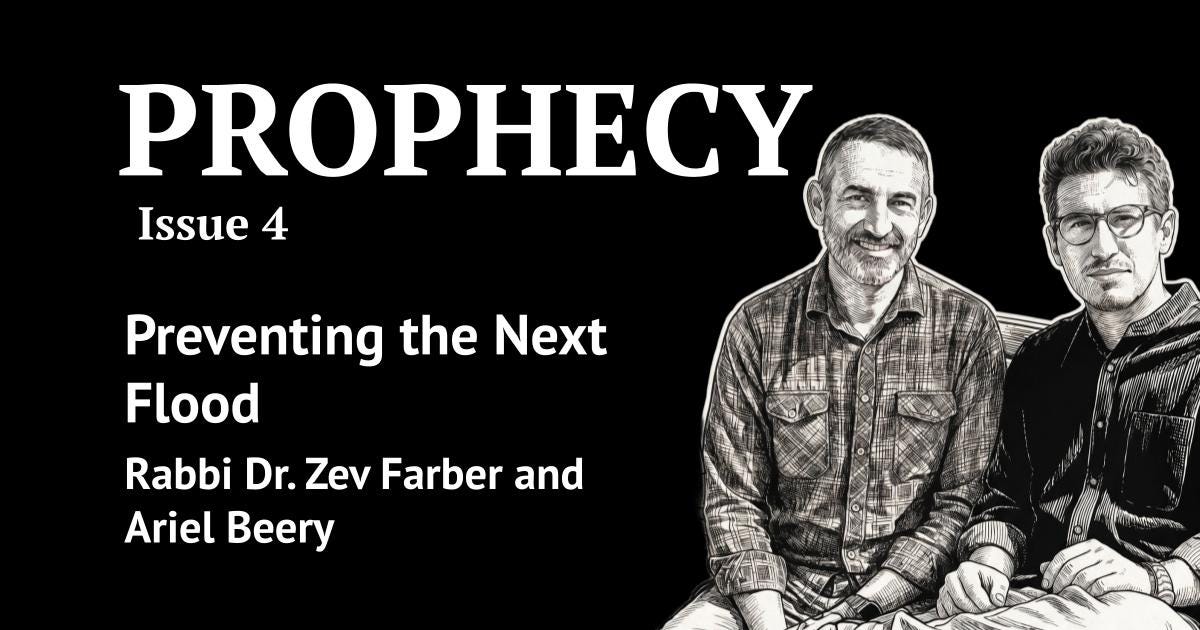
Rabbi Dr. Zev Farber is Senior Editor of TheTorah.com at the Academic Torah Institute, Research Fellow at Shalom Hartman's Kogod Center, and founder of Prisma, a project that seeks to draw on the wisdom of world religions while setting aside dogmatic claims. He holds a Ph.D. from Emory University in Jewish Religious Cultures and Hebrew Bible, an M.A. from the Hebrew University of Jerusalem in Jewish History, and rabbinic and advanced ordination from Yeshivat Chovevei Torah. Farber writes for both scholarly and general audiences on biblical criticism, theology, Halakha, Jewish ethics, and public life, and is co-author of The Bible’s First Kings: Uncovering the Story of Saul, David, and Solomon and editor of works on halakhic and biblical questions.
How did Prophecy’s editor and publisher, Ariel Beery, get to coauthor this big idea piece with such an accomplished scholar? Like most good things in life, it started with coffee at Tamar’s in Zichron Yaakov, and a common anxiety over climate change.
(We’re taking one more moment of your time to make sure you know that Prophecy is an actual journal available in an actual physical book! You can order it in print in Israel through Bookpod and worldwide through Amazon — as well as any and all of the ebook stores (Kobo, Apple, Everand, Etc) as well as Kindle.)
Preventing the Next Flood
By Zev Farber and Ariel Beery
Europe’s 2026 summer began with a record-breaking heatwave, sending temperatures above 40 degrees Celsius (104F), further melting what little ice caps existed across European mountain ranges and dehydrating fresh water sources across the continent. This comes just as new research published in the prestigious journal Nature proved that previous estimates of rising waters underestimated their extent: some coastlines around the world have experienced 3 feet of seawater rise already. Israel, in particular, is susceptible to these changes in climate, both in that the Levant is getting hotter faster than other regions, and because so much of Israel’s population currently lives along the coasts.
Those of us following events in the region, however, will recognize that this is not the first time floods threaten civilization as we know it.
Thousands of years ago, seawater covered what was once habitable land. Every animal that walked the land, whether mammal, reptile or insect, died; every home, street, and farm was destroyed. Worst of all, every human being that once lived upon that land was dead, food for the newly arrived fish and sea creatures. Other than, according to legends, one family floating alone upon the endless waters. Among them was one man who had seen what was coming and saved his family and a handful of animals they would use to repopulate fruitfully and multiply.
The cultures of the ancient Near East all spoke of this legendary hero, though the names for him vary: The Akkadians called him Atrahasis, meaning “exceedingly wise.” The Sumerians called him Ziusudra, “long life.” The Assyrians, Utnapishtim, “he found life.” The Bible calls him Noah.
This favorite of ancient Near Eastern legends turns out to be more than just a parable: 7,000 years ago, there stood a much smaller fresh water lake instead of the large Black Sea now bordering Georgia, Russia, Ukraine, Romania, and Bulgaria. The people living on its banks in the last days of this lake’s existence had no idea about long-standing geological processes that would bring the flood that would take most of their lives and destroy their societies utterly.
That process began 5.3 million years ago, when erosion caused the opening of the Strait of Gibraltar, and what was then a lush valley with freshwater streams became the Mediterranean and Aegean Seas, in an event called the Zanclean flood. This new body of water put pressure on adjacent land until 2.5 million years ago, when a fissure allowed water to pour through into another valley, forming the Sea of Marmora. The fissure is what we now call the Dardanelles. It took two million more years for the pressure on yet another weak piece of land for those waters to break through what we now call the Bosporus into that freshwater lake, 7,000 years ago, creating the Black Sea.
Why did this happen then? Geologists think it was due to the melting glaciers at the end of an ice age, which caused the seas to rise. The water became high enough to pour over the sill, which in turn began to erode, making the water come even faster, until the freshwater lake was overcome with the saltwater from the adjacent sea.
We know how that story ends: local inhabitants scattered, their crops and animals drowned, their houses underwater. Even those who likely escaped by running up the coast found little refuge as the fresh water they had relied upon turned unpotable by the endless pouring of the salty waters from the Sea of Marmora. That handful of healthy people we learn about who survived – by riding quickly, or running, or perhaps even by boat – were refugees, forced to move elsewhere and join other cultures. They brought with them the story of the flood waters and the warning we should heed today: once the waters come, it may be too late to run and hide.
And the waters are coming, and this time they will be pouring in everywhere.
Even climate skeptics recognize that humans have always lived in a period of quaternary glaciation (when the polar ice caps expand and retract in cycles), and that our generation is at the extreme end of what scientists call an interglacial period, when glaciers only exist on or near the poles. We are entering an age without glaciers, and not the first one: most of the Mesozoic Era (252–66 million years ago), when dinosaurs dominated the planet, was free of glaciers. The inverse also took place on our planet during the Cryogenian Period (720–635 million years ago) when Earth was covered by glaciers. We are living through the dynamic period of the cycle.
The consequences are, well, dire. Jeff Goodell lays out what we can expect in his 2017 The Water Will Come: Rising Seas, Sinking Cities, and the Remaking of the Civilized World, and common sense senses these changes without a need for up-to-the-minute data: When ocean levels rise, the water has to go somewhere, starting with the lowest level accessible territory and continuing on until the water level again hits equilibrium.
If we ignore the upcoming reality, the water will just decide where to go on its own, so to speak. It is likely that geologists can predict this with some accuracy, but one need not be a scientist to know that early victims will be coastal, lowland cities: Miami, New York, Amsterdam, Venice, and Tel Aviv, to name just a few. It is no secret that the majority of the world’s most influential cities have been built on the coasts.
Now there are many differences between our time and the Mesozoic, and how to prepare for a world with no glaciers is admittedly a tricky and more distant problem. But the first phase of this melt, which is already beginning, will be catastrophic in its own right. What can we do against this inevitable flood? One option is to redirect the waters, to make them flow where we want them to. And in our region, thanks to the buffers of the Mediterranean, we may be able to do so with relative ease.
In previous non-glacial periods, parts of the earth that are now deserts were seas. For example, the western Sahara Desert once contained the Sahara Sea, which stretched from the northern Algerian coast, south through Mali and Burkina Faso, and with many exit/entrance points stretching from Ghana to Cameroon. The Great Victoria Desert in Australia was once an inland sea, and North America, in the Cretaceous Period, was split into two continents by the Western Interior Sea, which stretched from Canada to the Gulf of Mexico. The rule of thumb is that deserts in glacial periods become seas in warmer periods. Which deserts get filled first, and which coastal cities are destroyed until those basins are filled, is up to us.
For example, in the Cretaceous period, the Tethys Sea covered much of the Middle East, including parts of Jordan and Saudi Arabia and this is where the water is heading, eventually. We suggest helping it on its way in a controlled manner for the benefit of the region and all countries involved, starting with the revival of an old project: the construction of two canals, one from the Mediterranean Sea to the Dead Sea and the other from the Red Sea to the Dead Sea was first suggested by a British naval officer, William Allen, as part of a solution for easier sailing to India (before the British and French dug the Suez Canal).
This concept was adopted by none other than Theodor Herzl, in his Altneuland, as a way of producing regional electricity.
Menachem Begin’s government in the 1980s adopted part of this plan (Med-Dead), to save the Dead Sea from evaporating totally, and the other part of this proposal was picked up by Shimon Peres and the Jordanian government (Red-Dead) for fish farming and water desalinization. Neither were undertaken for a combination of environmental, political, and economic concerns. Now that we know that the water is coming, it is a good time to revisit this.
If we want to survive the flood with Ashkelon, Ashdod, Tel Aviv, Netanya, and Haifa intact (to name only a few of Israel’s major cities along the water), we suggest beginning with Allen’s envisioned project as the first step. At the same time, Israel should collaborate with others to dig canals branching in other directions as well, filling some of the desert area in Jordan, giving that country an inland sea like the Black Sea or the Caspian. There, the Bible gives us a hint as to where the water could go: in the story of the Exodus the Bible refers to a huge fresh water lake, known as Suf (Rushes) that filled the Al-Jafr Basin. That lake is no longer there, and the desert that remains is sparsely populated. One can imagine canals running through solar-powered desalination facilities to pour potable water back into this catchment, returning Al-Jafr to the biblical Suf Lake it once was.
Both of these steps may be enough to provide a buffer to our coastal cities. Because of the bottleneck effect of the Straits of Gibraltar, scientists are estimating that the Mediterranean will rise by approximately 1 meter by 2100, which translates into about 2,500 trillion liters. While one in-land sea will not be enough to reduce that whole rise, there are options that could be useful. For example, Lake Lisan (of which remains the Dead Sea) once had a capacity of 800 trillion liters. We couldn’t fill all of it in, but we can refill some. The Al-Jafr basin in southern Jordan (where 6500 people live today in small towns and villages) has a theoretical capacity of 1350 trillion liters. And if that isn’t enough to temper the rise, in the Sinai there is the Wadi El Arish basin which theoretically could hold 218 trillion liters.
We are hardly the first to suggest this effort to save the coastal cities. Amir AghaKouchak, a professor of environmental and civil engineering at the University of California, Irvine, suggests reflooding the Qattara Depression, an in-land depression in Western Egypt. For now, Egypt has shelved the Qattara project on economic and environmental grounds, but as the global threat of flooding rises, they may revisit this. Together, refilling ancient basins in Israel, Jordan and Egypt could account for a good chunk of Mediterranean sea level rise this century. And that’s without adding in the Sahara, which itself was once a sea, which could help level off the Atlantic if it were filled, but because of its geographic spread would be politically more challenging to implement.
The ancillary benefits of adopting this plan reach far beyond saving our coastal cities. Just think of the value of all the new lake front property created! For water-poor Jordan, especially, inland lakes and seas have the potential of transforming its deserts into new sources of food security, major tourist attractions, and electric powerhouses– not to mention luxurious places to live.
And if it can be done with desalinated water, Egypt, too, could benefit from a whole new reservoir of potable water – especially since Ethiopia has shown no about-face in its damming of the headwaters of the Nile. Israel, a world leader in desalination technology, could make that happen by providing its technology as a means of achieving this, since the Jewish State has an interest in improving the Jordanian and Egyptian economies beyond just keeping our coastal cities from flooding and eventual abandonment. Collaboration on this scale could further regional economic development and perhaps even bring together our peoples under common cause.
But to make it work we need to start working now. A story is told about a pious man who was living on his own when his town began to flood. A truck appeared by his front door and the driver yelled, “Get on! The town is flooding!” But the man said, “Don’t worry about me. Go save someone else; God will save me.” Hours later, when he was knee-high in water, he climbed to the second floor. He saw a boat. “Get on!” said the man driving the boat, “the flood is getting worse.” “Don’t worry about me,” said the pious man, “save someone else; God will save me.” The waters rose still and the man climbed onto his roof. A helicopter hovered above his house and someone began to lower a ladder. “Get on!” said a man, “soon the water will cover even your roof.” “Don’t worry about me,” said the pious man, “save someone else; God will save me.”
When there was nowhere else for the pious man to go, he drowned in the flood. In heaven, the man stood before God and the archangels, confused. “I don’t understand! I was a pious man all my life, and I was sure you were going to save me. Instead, you just left me there to drown!” “What are you talking about,” responded the Almighty, “who do you think sent you the truck, the boat, and the helicopter?!”
The water is coming. But that doesn’t mean we have to drown in it. There will be ways of mitigating the damage, and, if done smartly, adding some major, tangible benefits on the way. The solution has been staring us in the face for over a century. We can prevent the destruction of our coastal cities if we only act on it.
Interested and have ideas on who can help bring this vision to life? Let us know!
More Prophecy awaits! Get the full issue on your ebook reader or in paperback today:
Can’t afford it? No worries! Articles from each issue, published quarterly, will be shared on a weekly basis for Substack subscribers. Subscribe to get at least one article per week, delivered to your inbox.
Are you clear on the future your organization is actually working toward—or are you operating under pressure without a defined direction?
Prophecy helps mission-driven leaders step out of reactive mode and into a structured process of visioning, strategic clarity, and decision-making. Through high-impact, future-oriented workshops—from 90-minute conversations to multi-day strategic sprints—we help teams align around shared values, explore plausible futures, and translate ambition into concrete priorities and next steps. If you’re ready to move from urgency to purpose, we’d welcome the opportunity to bring Prophecy to your organization. Contact: shalom@seekprophecy.com
This is so compelling.
Isn't the bigger problem desertification? Fundamentalist families seem intent on having seven or more children. Where's all the fresh water going to come from? https://www.sciencedirect.com/science/article/pii/S2214581826005100