

The Road to Normal
By Ben Koan
Wherein Ben Koan makes the case that the Promised Land is not triumph or vindication but something quieter: a Jewish State whose existence is no longer a question, and a people whose connection to their homeland requires no apology.
But first, let’s get to know the person behind the piece: Ben Koan
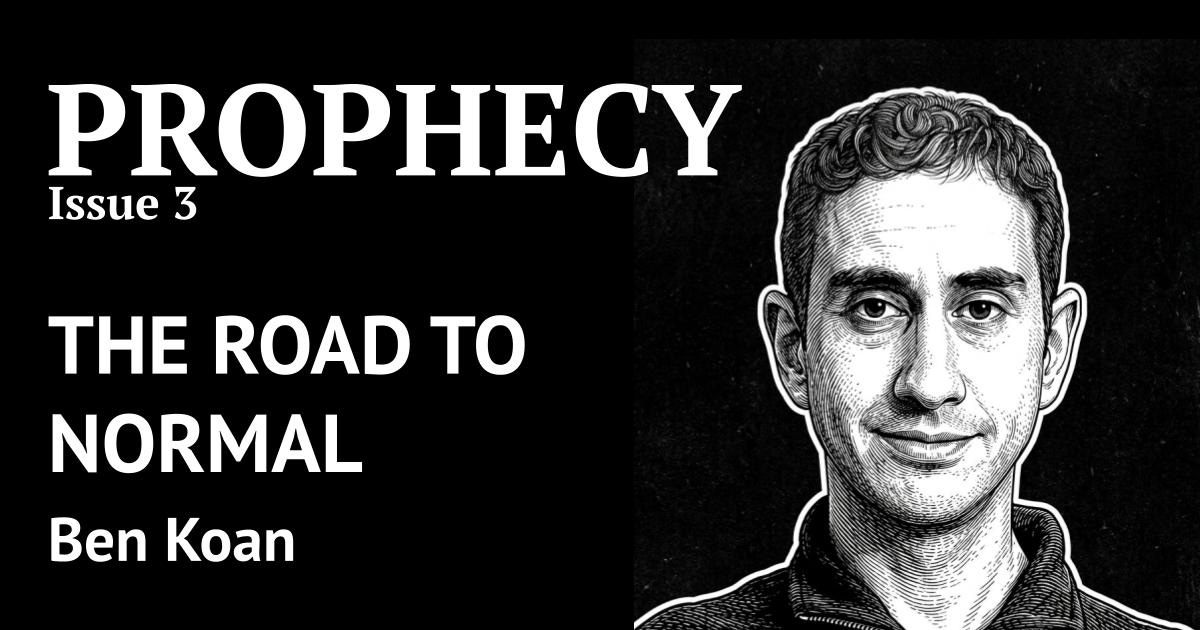
Ben Koan is a writer and editor whose work explores politics and ideas through the lens of long-term history. He is the author of The Thousand-Year View, a Substack newsletter that examines contemporary events within the arc of historical change, asking how the forces shaping the present may look from a wider perspective. His essays frequently address questions regarding the past and future of Israel and the Jewish people.
Born and raised in Ontario, Canada, Koan has spent much of his career working at the intersection of publishing, education, and technology. He currently serves as Editorial Director at an educational technology company and has extensive experience in publishing and e-learning. He lives in the Boston area with his wife and two young children.
The Road to Normal
By Ben Koan
Forty years from now, when my kids are old enough to have kids of their own, I want them to be able to tell a story about a period that is behind them. I want them to explain to their kids that Israel, which is in that future seen as any other normal state, was once thought of as abnormal, and isn’t that strange?
If you read the early Zionists, that was a motif: Israel becoming a nation like other nations. Israel’s Declaration of Independence refers to “the natural right of the Jewish people to be masters of their own fate, like all other nations, in their own sovereign State.” In a general sense, the idea is that Israel should be seen as a normal country. A normal country is not one whose existence is constantly questioned, where twenty-five-plus countries don’t recognize its existence formally, where large constituencies in countries that do recognize it also consider it illegitimate. The vision I support is normalization, which in Israel’s case, geopolitically means integration – integration into the region it’s in, which is a majority Muslim, majority Arab neighborhood.
We can sometimes get trapped in thinking in Jewish terms, which is why I find analogy useful. There’s a large Armenian community nearby where I live. It strikes me as kind of absurd to think that you’d need to apply a special label for Armenians who support the existence of Armenia. Obviously they do – it’s their homeland. It’s normal for an Armenian to care about Armenia, especially after the Armenian genocide. Isaiah Berlin, writing around the time Israel was created, saw the creation of the state as normalizing Diaspora Jews in a certain sense – Italian Americans have Italy, Irish Americans have Ireland, Jewish Americans have Israel. It’s normal to have a country with which you’re ancestrally associated.
That’s how it is for every people. George Washington understood this. His 1790 letter to the Hebrew Congregation in Newport, Rhode Island, stated plainly that the new republic would “give to bigotry no sanction, to persecution no assistance.” The children of Abraham were to be welcomed as what they were: a people with a particular history and a particular attachment to a particular land. Nothing unusual. Nothing requiring apology.
So what I hope is that forty years from now, this will be a period my kids describe to their own children as the worst of it – a wilderness they passed through. A period when to be Jewish, to be associated with Israel, was to be seen as abnormal. When every post on social media about anything Jewish would bring a torrent of comments – and “free Palestine” is the best you’d expect, and then it just gets darker from there. When kids felt like they had to whisper that they were Jewish in certain contexts. That’s what I’m hoping this period becomes: something they look back on as a formative difficulty that is, by then, behind them.
But I can’t promise that. And I think that distinction matters. The sociologist Philip Rieff wrote that “Prophesying is utterly different from prediction. It is in itself an effort to induce a right decision, or correct a wrong one.” To prophesy is to warn: if things continue the way they are, this is what’s going to happen. You can’t know what’s going to happen. But if you give up, if you don’t do anything about it, then that’s how it’s going to continue.
Taking the long view means not giving in to despair, and Jewish history is the ultimate case study in that, covering everything universally human in a particular way. Despite how terrible the past few years have been.we didn’t just go through the Holocaust. The State of Israel has not been destroyed. Iran has not dropped a nuclear bomb on Tel Aviv. You can imagine all kinds of apocalyptic scenarios, and we’re not living through the apocalypse. Even in terms of anti-Semitic attitudes: sure, it’s quite bad, but older generations experienced much worse. The institutional discrimination that existed within living memory in North America – in universities, in professions, in neighborhoods – is gone. Social norms are shifting in ways that feel alarming, but the shift hasn’t fully reached the mainstream, and there are reasons to think it won’t.
If we can keep that perspective and look at the present with that longer view in mind, we can see the seeds of the future already in it. Even during the war in Gaza, which has understandably inflamed public opinion around the world, the Abraham Accords did not shatter. When Iran launched missiles at Israel, Jordan helped in that defense. Those ties held through what we hope is the worst of it. The opportunity for lasting peace exists. Even in Iran today, among protesters against the government, there is substantial pro-Israel sentiment. In 1967, the Arab League summit adopted the Three Noes: no peace with Israel, no negotiation with Israel, no recognition of Israel. Since then, six Arab League members have established ties with Israel. The trend line, measured over decades, points toward the normalization that political Zionism always sought.
That trend matters for Jews around the world, too, because normalization of Israel and normalization of Jews are not separable questions. There will never be a clean separation between the two, even if you wanted there to be. Antisemites are going to put them together – and it’s not even just antisemites. There is something almost pre-political about it: roughly half of the world’s Jews live in Israel. That is why headlines about Israel affect Jews around the world and affect attitudes toward Jews, whether you think that’s right or wrong.
Sure, an Islamist attack on a synagogue in Britain because of what happened in Gaza is absurd, and yes, in the West, Russian Orthodox churches haven’t faced comparable attacks because of the war in Ukraine. And yet that’s the reality. Which means that as Israel is gradually normalized – and the trend is in that direction – so too, in time, will be the Jews.
October 7th was, for me, a moment of clarity about all of this. I was at home with my kids. I remember the reports coming in and, while the full scale of it was not immediately clear, I was doing a lot of doom-scrolling, reading headlines, seeing what people were saying. What I found there was disturbing, but clarifying in a particular way. I saw something like it before: when 9/11 happened, there were people in my high school who were happy it happened, who felt that America had it coming. That was formative for me. A kind of clarity: there are people like that out there. We can’t assume everyone has the same outraged reaction to evil.
October 7th was like that, except amplified, because there is social media now and because America has many more sympathizers than Israel. I scrolled through tweets saying it deserved to happen; voices on the left with no compunction about celebrating a massacre. As much as seeing that reaction is painful, the clarifying aspect is knowing who showed humanity and who didn’t. When bonds are most severely tested, you find out who people really are. It’s painful clarity. But it’s clarity.
The aftermath of October 7th also disabused me of the distortion that doom-scrolling creates. The same event that revealed rot in certain parts of academia and beyond – the settler-colonial framework, the oppressor-oppressed binary applied without reflection – also spurred a local politician to speak at a memorial service for the victims. It led a non-Jewish friend to call me and express his horror. The internet makes it feel like the entire world is against you. It isn’t.
And October 7th prompted in me, more than anything, the urge to read. I was already interested in Jewish and Israeli history, but this pushed me further. To challenge myself. To recognize that Israel has done certain things one may not approve of. The War of Independence, for example, was an often ugly battle for survival, not a simple story of good and evil. Confronting that is important because one should understand the best arguments on both sides of any issue and be capable of engaging with them. It reminded me that people who are critical of Israel are not grasping at straws – there are realities they can grasp at. Acknowledging this, engaging with their objections seriously, makes one’s conclusions more convincing, and advocacy more effective.
I have come to conclude that for us to advance the cause of the normalization of Israel we need to frame our advocacy in the North American context in the language of universalism – but of a particular kind. The universalism that acknowledges that the way the Jews connect to the State of Israel is not abnormal – it is analogous to how many other peoples relate to their homelands. The acknowledgement that classical liberal thinking places religious liberty and national self-determination at its center. That claiming these rights for the Jews is not special or unique. It is the application of principles that the tradition already holds.
My kids are four and two. They will grow up in whatever world we make of this moment. What I want for them – what I think is actually achievable, if we do the work – is to live in a world where Jews are ordinary. I want them to be able to say, without lowering their voice, that they are Jewish, that their people have a country, that the country is in the Middle East and is called Israel, and that none of this is unusual. The way it is not unusual for a Diaspora Armenian to care about Armenia, or for an Irish American to feel something when Ireland is mentioned, or for an Italian American to have a flag on their wall. Normal. Just normal.
That’s a future I believe worth working towards: not triumph, not vindication, just the unremarkable status of a people among peoples, a nation among nations, as the Declaration said, like all other nations. If my grandchildren can hear the story of this period the way we hear stories of other darknesses that passed then the work will have been worth it. And if we don’t try, we already know how the story ends.
More Prophecy awaits! Get the full issue on your ebook reader or in paperback today:
Can’t afford it? No worries! Articles from each issue, published quarterly, will be shared on a weekly basis for Substack subscribers. Subscribe to get at least one article per week, delivered to your inbox.
Next week: Jordan Chandler Hirsch argues that the postwar logic of American Jewish life — power enjoyed quietly, identity managed carefully — has run its course, and that what the community needs now is reignition: treating its distinctiveness not as a liability but as a gift to American pluralism.
Are you clear on the future your organization is actually working toward—or are you operating under pressure without a defined direction? Prophecy helps mission-driven leaders step out of reactive mode and into a structured process of visioning, strategic clarity, and decision-making. Through high-impact, future-oriented workshops—from 90-minute conversations to multi-day strategic sprints—we help teams align around shared values, explore plausible futures, and translate ambition into concrete priorities and next steps. If you’re ready to move from urgency to purpose, we’d welcome the opportunity to bring Prophecy to your organization. Contact: shalom@seekprophecy.com